VISION
India and Japan, share a common vision of leveraging science and technology as key drivers of progress and prosperity of the human society.
view


India and Japan, share a common vision of leveraging science and technology as key drivers of progress and prosperity of the human society.
Research Collaboration.
Technology Transfer and Innovation.
Educational Exchange.
Bilateral Agreements.
Public & Private Sector Participation.
Policy Support


India Japan Society for Science, Technology and Education was founded with the aim of fostering collaboration, sharing expertise and promoting mutual learnings through exchanges of knowledge in the realms of Science, Technology and Education between India and Japan, as well as encompassing rich cultural exchanges.
India and Japan, share a common vision of leveraging science and technology as key drivers of progress and prosperity of the human society. Recognizing the mutual benefits of collaboration, both countries have committed to fostering robust partnerships in the realm of science and technology. India Japan Society for Science, Technology and Education encapsulates this vision, aspiring to forge a platform for collaborative research, technological innovation, and knowledge exchange. By cultivating partnerships and facilitating educational exchanges between India and Japan, substantial strides in science and technology will be made, ultimately benefiting both nations while addressing some of the global challenges. This collaboration is poised to inspire the progress and prosperity in the scientific community and beyond.
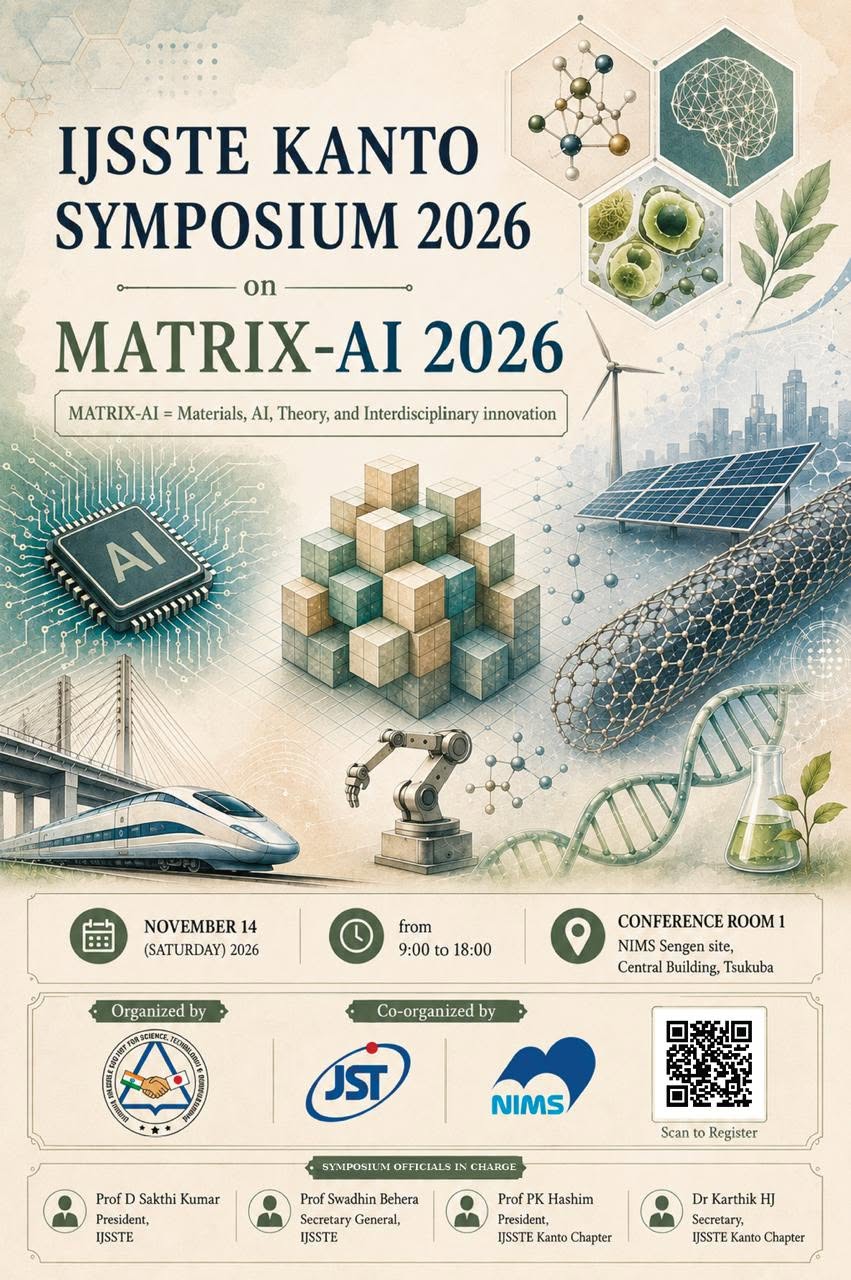
The India Japan Society for Science, Technology and Education (IJSSTE) (www.ijsste.org) Kanto Chapter is pleased to announce the IJSSTE Kanto Symposium 2026 on MATRIX-AI 2026, a premier interdisciplinary event bringing together researchers, academicians, industry experts, and students to explore the transformative convergence of Materials Science, Artificial Intelligence, Theory, and Interdisciplinary Innovation (MATRIX-AI).
This symposium will provide a dynamic platform for knowledge exchange, collaboration, and discussion on emerging technologies that are shaping the future of advanced materials, intelligent systems, sustainable energy, biotechnology, robotics, transportation, and data-driven scientific discovery.
Date: Saturday, 14 November 2026
Time: 9:00 AM – 6:00 PM
Venue: Conference Room 1, NIMS Sengen Site, Central Building, Tsukuba, Japan
Organized by the India-Japan Society for Science, Technology and Education (IJSSTE), co-organized by the Japan Science and Technology (JST) and the National Institute for Materials Science (NIMS)
For more information and registration, please visit the home page: https://matrixai2026.netlify.app/
For poster registration: https://docs.google.com/.../1FAIpQLScMU6PVnBXuoq.../viewform
We warmly invite researchers, faculty members, students, industry professionals, and innovators to join us in Tsukuba for a day of cutting-edge scientific discussions and collaborative opportunities.
Facilitate joint research initiatives between Indian and Japanese scientists and researchers.
Promote interdisciplinary collaborations to address global challenges, including climate change, healthcare, and sustainable development.
Establish mechanisms for the transfer of technology and expertise between industries and research institutions.
Encourage joint ventures and innovation clusters to catalyze technological advancements in key sectors.
Foster academic exchange programs to facilitate the sharing of knowledge and expertise between educational institutions in both countries.
Encourage student and faculty mobility to promote a diverse and global perspective in scientific research and education.
Support the growth of a vibrant entrepreneurial ecosystem by facilitating collaboration between start-ups, investors, and incubators.
Create platforms for knowledge sharing and networking to accelerate the development of technology-driven enterprises.
Invest in training and capacity-building programs to enhance the skills of scientists, engineers, and researchers.
Promote joint workshops, conferences, and skill development initiatives to address emerging trends and technologies.
Strengthen existing bilateral agreements and forge new partnerships to formalize collaborative efforts.
Establish joint committees to oversee the implementation of collaborative projects and address challenges.
Ensure policy frameworks that incentivize and support collaborative efforts in science and technology.
Provide funding mechanisms for joint projects and initiatives.
Develop a robust communication network to facilitate the exchange of information, research findings, and best practices.
Utilize digital platforms to enhance connectivity and collaboration.